Lucy Hamilton
Australian media hacks (always) get dismantled by facts
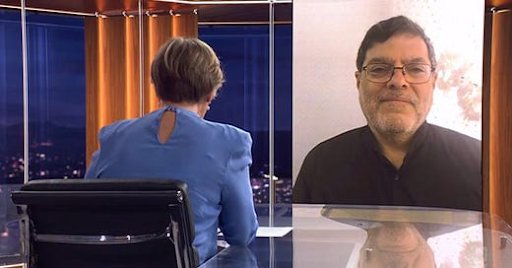
Distinguished academic and prominent global figure Iranian Professor Saied Mohamed Marandi appeared on ABC’s 7.30, where Sarah Ferguson — the national broadcaster’s most distinguished flagship interviewer — prepared to ask the tough questions she reserves for certain guests. The interview was an outright failure, and an example of the unique way Australian journalism interacts with reality.
Off the bat, Ferguson asked, “What right does Iran have to hold the world to ransom?” in relation to the closure of the Strait of Hormuz. “Excuse me,” replied Marandi, “I think it was the United States who waged a war against Iran and your government supported it.” The professor then went on to remind Ferguson and her viewers of the broader situation. Ferguson stuck rigidly to her prepared questions, jumping back into Iran’s position on the Strait of Hormuz and her claim it breached the Memorandum of Understanding (MOU). Marandi calmly explained the violations of the MOU that led to its dismissal. Ferguson clumsily moved to the next question, unable to adapt to the barrage of facts coming her way or the pedigree of the person delivering them.
For months since the Israel–US attacks that triggered the current Iran crisis, the national broadcaster has been platforming pro-Western voices and their subjective takes on Iran, while Iran is defending itself from aggression, as Marandi claims. In a political environment where the government has openly or tacitly supported a conflict that has shut down parts of the global energy supply chain and threatens to escalate beyond a regional war, the press has played a crucial role in defining the reality of the conflict. Yet it has only defined one particular version of that reality.
It is the version that glosses over the significance of the Albanese government jumping in early to support what many regard as an illegal war. It is the version that omits the presence of Australian naval personnel aboard the US submarine that surprise-attacked the Iranian warship IRIS Dena. A position that overlooks the Minab school bombing. And it is a reality that frames the Iranian regime solely through the lens of a global sponsor of state terror, a nuclear threat, and an ideologically repressive society hated by its people. This framing is reinforced by the subjective quips of selective guests and the disingenuous inquiries of Ferguson.
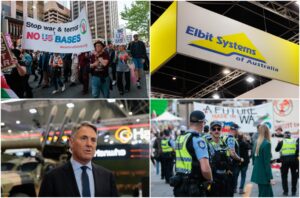
To sustain this inversion of reality, independent Iranian voices like Professor Marandi have been largely absent from the analysis. Instead, senior Australian officials such as Penny Wong and Richard Marles, alongside figures like former Israeli PM Ehud Olmert, Israel’s ambassador Hillel Newman, David Petraeus, Rafael Grossi, and Kylie Moore-Gilbert have been given free rein to shape the narrative — focusing on degrading Iran’s capabilities, regime brutality, and Australia’s duty to back the Trump–Netanyahu position.
Even exiled Crown Prince Reza Pahlavi — a pariah in Iran — has been platformed by the ABC to argue for US intervention. Meanwhile, a nihilistic apathy has taken hold across the press: between echoing elite narratives and projecting the desires of the powerful, many Australian journalists have become content to parrot lines on war, militarism, and even genocide rather than interrogate them. Pre-loaded questions, often seemingly drawn from Canberra or Washington talking points, are rarely challenged, even when they expose glaring deficits in subject-matter knowledge.
This combination of selective platforming and intellectual complacency was on full display in the Marandi interview itself.
The interview with Marandi was a textbook example of this pathology of Australia’s media class: the inherent subjectivity of the craft, the dilution of its efficacy and utility, and the poor knowledge base of many Australian journalists. Nothing speaks more to the insularity and vapidity of the Australian press than the visible underwhelm and disappointment of distinguished international figures when they engage with it — as Marandi did, and as many others have.
The same insularity and double standards extend well beyond this single encounter. Prominent Chinese commentator Victor Gao and the Russian Ambassador Alexey Pavlovsky are grilled, interrogated and interrupted. Richard Marles is allowed to mumble incoherently about AUKUS. Penny Wong is rarely pushed on her hypocritical claims about international law. Epstein-linked former Israeli PM Ehud Barak receives a platform to spruik the ramping up of death and killing in Gaza, while Marandi is blamed for his country defending itself against a belligerent attack.
Dr Marandi is a highly credentialed academic — one of Iran’s most prominent — with an academic pedigree matched only by his media literacy and savvy. A seasoned speaker who has faced hostility from Piers Morgan to Fareed Zakaria, he has engaged the top-ranking Western media spin doctors. Ferguson was meant to be among them, but came off as one of the more rigid interviewers in the West, exhibiting a prevalent Australian media dynamic that stands out among others.
Ferguson needed to have her facts straight and use them to challenge Marandi and Iran in the most pro-Western way possible. Instead, she lacked command of the subject matter, barged through inconsistencies when corrected, and retreated to prepared lines — a common pattern in hotly contested Australian political interviews.
The bubble surrounding the Australian media is soundproof and often opaque to realities outside Canberra’s cafeteria feeds and the brunch zones of major cities. Australian journalists remain cloistered and detached. In a world where Western narratives are shaped by Epstein-linked leaders loyal to Israel conducting war and genocide, billionaires stoking division and hoovering wealth, and mega-corporations enabled by politicians, it was incumbent on the Australian media class not to become stenographers for power — or, in the case of the ABC, enablers of empire narratives that run counter to the national interest and erode its ability to accurately inform Australians.
UN Special Rapporteur Francesca Albanese’s address before the National Press Club was a great example of the glaring deficits of Australian media in action. Albanese was visibly shocked at the quality of questions from the Canberra press gallery, and the distinguished foreign guest called the level of media understanding of complex world events “very basic”. A claim that is evidenced in the callous interviews conducted in #auspol, as seen in action during the Marandi interview, and experienced in the shallow logic exhibited across the concentrated media apparatus of Australia. A good international guest is often left dumbfounded by Australian media, just ask legendary journalist Chris Hedges.
If the flagsip current affairs program on the national broadcaster can’t conduct a good interview in this country, who can? Karl Stefanovic? The rigidity of the loaded questions, the disingenuous claim to seek impartiality designed to drive the interviewee into a corner, denies the claimed objective of conducting the interview in the first place: to objectively inform the public. In the ABC’s case, as per the charter. Australians don’t want a loaded half-arsed gotcha session from Ferguson parroting the same lines as the commercial outlets — they want to be informed of important issues by an objective operator at the ABC.
The sight of an underwhelmed international figure frustrated by the tradecraft of Australian journalists is increasingly common — as is the frustration of Australian audiences watching. This subjective rigidity, which only permits certain questions for predetermined outcomes, is rapidly eroding the reach and credibility of legacy media and the skill of its practitioners. A point not lost in the haemorrhaging ratings and disintegrating structures in the industry, and the unsustainable consequences of continuing to do news in such a manner. One has to ask whether they still know how to do their job, if they are scared to do it, or whether they are doing something else entirely. Or, do they even care?
“Don’t the people of Iran deserve peace?” trudged Ferguson, before accusing Iran of having a nuclear weapons program it does not possess. Marandi corrected her, set the record straight on the real obstacles to peace, and held her to the false claim. Ferguson ignored it and pushed back into her subjective corner about the MOU. “You’re not very much of a journalist, are you?” Marandi replied, sweeping away the last subjective take. “Because you are Australian, and you are affiliated with the state — since you have been supporting genocide in Gaza… I don’t expect anything from you.”
Subscribe to The Shot
The Shot newsletter is the best way to keep up-to-date with the independent outlet without having to scroll through the hell of social media.

The Sunday Shot
The Shot’s Jo Dyer and Dave Milner are joined each week by a roster of Australia’s best independent journalists and thinkers to discuss what’s been happening this week in politics.

Advertisement