Joel Jenkins
Australia’s shitty media missed the significance of Albanese’s China visit
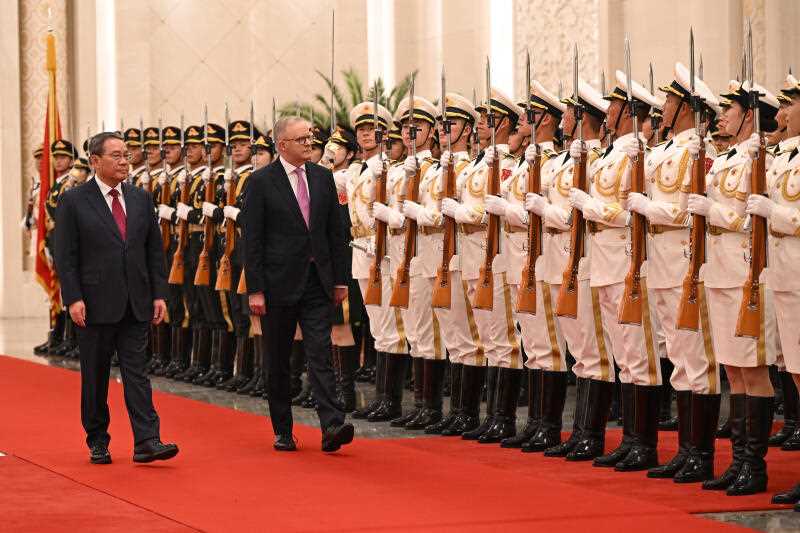
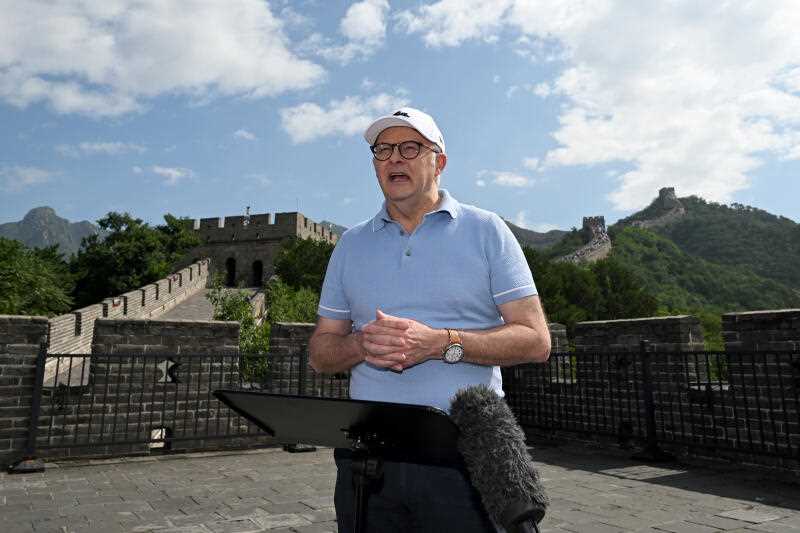
In six days, Prime Minister Anthony Albanese visited three Chinese cities, including a symbolic stop at the Great Wall, where he made key announcements affirming the vital Sino-Australian relationship. As the Trump administration sidelines Australia and global dynamics shift dramatically, the trip carried undeniable strategic weight. Yet, the Australian press corps largely overlooked this pivotal moment, missing a chance to spark a critical national conversation about Australia’s sovereign future.
Prime Minister Anthony Albanese appeared reflective as he addressed cameras at the Great Wall, praising China’s history and achievements. He highlighted the Whitlam government’s recognition of China and the enduring relationship between the two nations, emphasising its mutual benefits. Albanese smiled as he noted that the band at the previous night’s business leaders’ meeting in Beijing’s Great Hall played renditions of Paul Kelly’s “To Her Door” and Midnight Oil’s “Power and the Passion.” “Those gestures matter; respect matters between countries,” he remarked, standing on the same section of the Great Wall Gough Whitlam visited in 1971.
“Albanese rejects criticism of visits to pandas, Great Wall as ‘indulgent’, says China tour was about ‘respect’” wrote ABC foreign affairs correspondent extraordinaire Stephen Dziedzic, seeming to miss the forest from the bamboo. “Picture bigger than Albanese’s visit: Xi Jinping sees Australia as fruit ripe for plucking”, imagined the dreamy punditry of Peter Hartcher in the Nine papers that we have become accustomed to over the years.The pattern of subjective indulgence would only continue.
The Australian press accompanying the Prime Minister failed to capture the broader significance of his China visit. Rather than contrasting the strained relationship with Trump’s Washington or highlighting the Chinese market’s critical role in sustaining Australia’s economy, they neglected to engage the public on vital issues. Nor did they explore the centuries-long history shaping the unique Sino-Australian relationship. Instead, reporters fixated on predictable questions about China’s “military buildup,” “Taiwan”, the “Port of Darwin”, and “US actions”.
Analysis of Australia’s sovereign future between our largest trading and military partners has been reduced to “Albo hasn’t met trump” and “China is bad”, a terrifying one way-line of enquiry echoing around the trip’s press conferences. The lack of nuance, realism, or reason was unavoidably evident around the delivery of questions – lacking journalistic curiosity – seeming to look for the gotcha moment or a statement that could contradict the optics of the trip.
Albanese’s visit to China delivered significant gains including a ChAFTA review, critical new dialogues on steel decarbonisation and tourism, and enhanced business opportunities in critical minerals, agriculture, and healthcare. It was almost a once-in-a-generation diplomatic moment, but the press wasn’t interested.
SMH/Age international and political editor Peter Hartcher likened the press pack’s approach to the visit to “little kids walking past a haunted house,” expecting a scare that never materialised. In one of the few analytical pieces in legacy media, even Hartcher — who co-wrote the atrociously irresponsible Red Alert series in Nine newspapers, warning of an imminent Chinese threat to Australian soil — acknowledged the significance of the green steel deal and the strained relationship with Washington.
The Australian media often portrays China with a mix of the outdated ‘yellow peril’ trope and Tomorrow, When the War Began-style paranoia. While China builds transcontinental high-speed railways with its economic partners, the Australian media’s hive mind fixates on ominous, regressive fears, fostering a belligerent narrative that shapes public opinion against our largest trading partner and the world’s most advanced economy.
Anti-China sentiment is woven into modern Australian history. From tensions with Chinese immigrant communities generated during the gold rush, continuing at the turn of the 20th century and into the ‘reds under the bed’ propaganda fuelling anti-Chinese attitudes in the 1950s and 60s, undercurrents of distrust have persisted. The Australia-China relationship peaked around 2015 with the China-Australia Free Trade Agreement (ChAFTA), but soon deteriorated as historical tensions became political footballs for ideologically opposed leaders.
The Coalition coup that saw elected Prime Minister Malcolm Turnbull replaced by Scott Morrison also saw a change in the way the Coalition perceived China. The press eagerly followed, amplified by escalatory rhetoric from Washington. Before you knew it, Foreign Minister Julie Bishop was criticising China’s political system; in 2018, the Huawei ban further soured relations; in 2020, Morrison called for an independent inquiry into COVID-19’s origins; and in 2021, AUKUS was announced. The relationship never recovered.
It was around this time that the press changed its editorial concepts around China to a more subjectively batshit narrative, in line with Washington’s China hawks and dreamed up by ideologically compromised think-tanks like the Australian Strategic Policy Institute (ASPI). This was the era that ‘Red Alert’ was born. There were fewer articles about the benefits of Australia-China cross-cultural experiences, and more about the fear of total-war with China.
For over two decades, China has been the cornerstone of Australia’s economic success, with bipartisan support for this vital relationship. The resources sector — exporting iron ore, coal, and gas — has become a global powerhouse, while export markets and affordable imports have transformed Australian stores, homes, and roads. This unique economic partnership shielded Australia from the worst of the Global Financial Crisis, even as we fought in America’s costly war on terror. Today, Beijing, our top trading partner, hosts banquets for the Prime Minister, while our allies in Washington leave us sidelined in diplomatic standoffs.
Anthony Albanese’s China visit could have been a defining moment, a chance to reposition Australia amid a rapidly shifting global landscape. Yet, the Australian media squandered this opportunity, failing to ignite a critical national conversation about our strategic and economic interests. While Beijing welcomed the Prime Minister with open arms, thawing decades of tension, and a belligerent US pushed tariffs and coercion, the press fixated on whether Albanese was “botching it” by not meeting Trump or challenging the “One China policy” on Chinese soil.
A robust media would have probed the reasons behind these global shifts, their implications, and Australia’s options for navigating them. Instead of recycling fear-driven narratives. It’s long past time for our media to foster the informed debate needed to secure our nation’s future in an uncertain world.
Subscribe to The Shot
The Shot newsletter is the best way to keep up-to-date with the independent outlet without having to scroll through the hell of social media.

The Sunday Shot
The Shot’s Jo Dyer and Dave Milner are joined each week by a roster of Australia’s best independent journalists and thinkers to discuss what’s been happening this week in politics.

Advertisement