Dave Milner
Thought control

In societies which call themselves open and free, where elites cannot easily control the general population with violence, opinion management by other means remains the holy grail.
This is despite the fact that state propaganda and indoctrination are supposed to be exclusive characteristics of unfree and totalitarian states at both ends of the ideological spectrum.
The danger of defining our society in opposition to less desirable ‘others’ is that it relieves us of the burden of introspection and self-criticism. It may be reassuring to know that other communities are demonstrably less advanced and privileged than ours but it inevitably leads to complacency and misplaced assumptions about our own capacity for free thought and expression.
George Orwell offered an explanation of how thought control operated in liberal democracies. In an unpublished introduction to Animal Farm Orwell warned that “the sinister fact about literary censorship in England is that it is largely voluntary. Unpopular ideas can be silenced, and inconvenient facts kept dark, without any need for an official ban.”
In liberal societies, voluntary censorship is certainly more effective than the coercion practiced by dictatorships, which only encourages resistance to authority. In democratic states, ruling elites cannot easily control the population by violence. They must use more subtle and sophisticated mechanisms to maintain what Orwell called “smelly little orthodoxies.” So how does voluntary thought censorship operate in open societies?
One line of argument claims that the challenge for elites is to combine effective indoctrination with the impression that society is really free and open. This can be done by setting the intellectual boundaries within which legitimate ideas can be freely expressed. According to Ed Herman and Noam Chomsky, these boundaries are most effective when they are implicit and presupposed, and rarely when they are openly dictated by the state.
According to Chomsky, “a principle familiar to propagandists is that the doctrine to be instilled in the target audience should not be articulated: that would only expose them to reflection, inquiry, and, very likely, ridicule. The proper procedure is to drill them home by constantly presupposing them, so that they become the very condition for discourse.”
Presuppositions then act as the framework for “thinkable thought” instead of being assumptions which can be challenged. The debates and dissent which we believe characterise our freedom are permitted and even encouraged, but within tightly prescribed and largely invisible boundaries, leaving us with the comforting impression that our societies are open and free. According to Chomsky, “the smart way to keep people passive and obedient is to strictly limit the spectrum of acceptable opinion, but allow very lively debate within that spectrum.” As Milan Rai argues, “we can no longer perceive the ideas that are shaping our thoughts, as the fish cannot perceive the sea.”
The two-party parliamentary system functions this way. Policy proposals which lie outside the thought guardrails of the “major” parties, whether they come from “minor” parties, independents or petitioners, are easily dismissed as “extreme” or outside the mainstream, suggesting they are unworthy of serious consideration.
The discussion of foreign and defence policy, for example, should be left to the “responsible” men and women of what Tariq Ali calls the “extreme centre.” The underlying purpose of the extreme centre is to ensure that the broad contours of public policy – for example the US alliance – do not change regardless of which political party is in power. Politics forms a duopoly where bipartisanship and policy continuity are functional goals which circumscribe the range of legitimate policy proposals. The best example is the US political system which, until Trump, was effectively a one-party state with two factions, Republicans and Democrats, competing for the trappings of office but offering few meaningful policy choices to American voters.
If you oppose the AUKUS submarine boondoggle, as many Australians do, and think government already spends more than enough on defence, you will not only be accused of being soft on defence. Your concerns will be ignored regardless of which party occupies the Treasury benches. The decision was beyond the knowable: taken in secret by the Morrison Government and ratified by its successor without any public consultation. As with the Iraq war and Israel’s genocide in Gaza, AUKUS is a perfect example of how bipartisan politics in the Parliament trumps public opposition and, in this case, community involvement in decision-making.
If you believe that Israel committed “state terrorism” in Gaza you will soon discover that no such concept exists within the spectrum of legitimate thought about the Middle East unless it applies to Iran. Groups such as Hamas and Islamic Jihad are officially designated “terrorist” to indicate that they pursue a cause which “responsible opinion” in Australia, most importantly within the Federal Parliament, opposes. The legal right to violently resist a vicious and illegal occupation which since October 2023 has taken the form of a genocide, is unmentionable. Unsurprisingly and despite a long history of violent interventions around the world by the United States, Western state terrorism is a non-subject in the West. After all, Western civilisation is apparently at stake here.
That the leader of a state (Israel) within the liberal democratic club can be indicted for war crimes and crimes against humanity poses a challenge for the gatekeepers of thought in the West. Three responses illustrate how uncomfortable facts like this are dealt with. First, the court issuing the indictments (the International Criminal Court) is attacked and its officers are targeted for character assassination while having their electronic communications blocked and disrupted. Secondly, states which intend to honour their obligations to the court under the Rome Statute are threatened with sanctions by Washington should, if given an opportunity, they discharge their responsibility to apprehend him. Thirdly, when Western media refer to Prime Minister Netanyahu, his indictment by the ICC is initially rendered as “controversial,” “denied by him” and then unmentioned from that point on. Contrast his treatment with that of his fellow ICC indictee, President Vladimir Putin: not just a double standard but also a wilful manipulation of public opinion.
Stasis versus change
The manner in which legitimate ideas are circumscribed in free societies can be understood in another way.
In his assessment of the impact of recent developments in social theory for the study of International Relations, Robert Cox claims that problem solving theory “takes the world as it finds it, with the prevailing social and political relations and institutions into which they are organised, as the given framework for action. The general aim of problem-solving theory is to make these relationships and institutions work smoothly by dealing effectively with particular sources of trouble.”
Problem solving theory does not challenge the pattern of relationships and institutions in question and can “fix limits or parameters to a problem area” which in turn constrains “the number of variables which are amenable to relatively close and precise examination.” Problem-solving theory “is not merely a convenience of method, but also an ideological bias. Problem-solving theories can be represented … as serving particular national, sectional, or class interests, which are comfortable with the given world order. Indeed, the purpose served by problem-solving theory is conservative, since it aims to solve the problem arising in various parts of the complex whole in order to smooth the functioning of the whole.”
Critical theory, on the other hand, “stands apart from the prevailing order of the world and asks how that order came about. Critical theory, unlike problem-solving theory, does not take institutions and social and power relations for granted but calls them into question by concerning itself with their origins and how and whether they might be in the process of changing. It is directed towards an appraisal of the very framework of action … which problem-solving theory accepts as its parameters.” Whereas problem-solving theory is “a guide to tactical actions which, intended or unintended, sustain the existing order”, critical theory provides “a guide to strategic action for bringing about an alternative order.”
For those opposing change and seeking continuity, problems which arise within a society’s political economy or with its strategic alliances need to be addressed within the existing socio-economic and defence structures.
***
Systemic financial crises in state capitalism have to be ameliorated – normally with government intervention – but within existing class structures to perpetuate the ‘market’ system with all its inequalities and disparities of wealth and power. Despite the evidence that its stability cannot be maintained for long periods of time, a crisis-prone global economy that is too complex for rational management cannot be the conclusion reached by the public no matter how regular, unexpected and devastating the crises become (e.g. the global financial crisis of 2008).
Were that to happen, a legitimation crises would soon follow and that has to be avoided at all costs. Opinion management has to ensure that despite its vulnerabilities and periodic crises, the public continues to believe that the overall economic system is not at fault, there is no superior model, and that only some of its internal features need adjustment. This is despite many of its stabilising features being socialist (the welfare system, medicine and health insurance, public housing and transport), hence the more accurate description: state capitalism. Nonetheless, socialism has to be continuously demonised and placed beyond the bounds of legitimate thought.
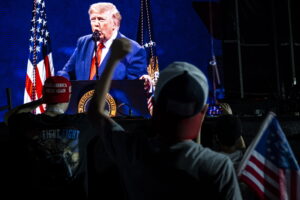
Because of his deep unpopularity in Australia, President Donald Trump – like George W. Bush before him – has to be insulated from public attitudes towards the US alliance. Alliance boosters cannot allow alternative strategic arrangements – independence or non-alignment – to gain traction in public debates, let alone within elite circles. The unspoken assumption is that Australia is now, and forever will be, incapable of self-defence.
A great deal of time and money is invested by groups such as the Australian American Leadership Dialogue (AALD) into socialising current and future leaders into the overwhelming importance of the US alliance. The resulting bipartisanship is a tribute to how successful this process has been. The challenge of keeping the public on board when they are repelled by the occupant of the White House is more difficult.
The need to separate the importance of the alliance from the incumbent President will be severely tested over the next three years and beyond. Governments in Australia know there are limits to how far the gap between policy and public opinion will stretch before it breaks. The worst outcome for elites, therefore, is that independence in defence and foreign policy enters the realm of thinkable thought because of the reckless and obnoxious behaviour of our friend in Washington.
And if universities cannot be trusted to conduct lively debates within a spectrum of acceptable and legitimate opinion, think tanks such as the privately owned Lowy Institute and the Australian Strategic Policy Institute (ASPI), funded by government and the arms manufacturing sector, certainly can. They have safe ideological hands and will never stray far from the extreme policy centre.
Government propaganda aims to achieve two specific objectives.
First, it wants citizens to believe that a transitory, historical state of affairs (a foreign policy alliance or a particular configuration of political economy) is in fact a permanent and natural condition of their lives: that these arrangements are timeless, have no pre-history and cannot be improved upon.
Secondly, they seek political hegemony so ruling elites can rely on the voluntary compliance of subordinate groups, in particular their acceptance of unequal economic and power relations.
As Antonio Gramsci argued, hegemony exists when the key ideas and interests of ruling groups are accepted as legitimate even by those who have least to gain from them. It becomes a structural force which constrains debates and discussion about policy choices. Mass compliance retrospectively confers legitimacy on those ideas and interests.
Tightly defining the spectrum of permitted expression is a highly effective form of ideological control. Governments understand that the marketplace of ideas has to be regulated in the traditional way: by state intervention.
It is unsurprising that in response to the reputational damage its genocide in Gaza has induced – especially amongst traditionally supportive young American Jews – Israel has targeted social media and Artificial Intelligence to rehabilitate its image. Pressing for the sale of social media platforms such as Tik Tok to pro-Israel billionaires, paying ‘influencers’ on X, Instagram and Facebook to post pro-Israel material, and adjusting social media and AI algorithms to direct scrollers unwittingly to pro-Israel opinion and websites is how opinion management operates today. When it doesn’t happen organically, the state steps in.
Paradoxically, controlled dissidence, or what Chomsky calls “feigned dissent” which occurs within the parameters of legitimate thought, has the effect of reinforcing existing political and economic arrangements by appearing to oppose elite interests, while not actually challenging them at all. The claim that within free societies a great battle of ideas is taking place is mostly untrue because views which lie outside the elite consensus – for example that Israel is a rogue, apartheid state which commits state terrorism – are “voluntarily censored” from any “practical” and “sensible” discussion of policy responses and options.
Orwell warned that in a democracy an orthodoxy was “a body of ideas which it is assumed that all right-thinking people will accept without question.” Gramsci’s notion of “common sense” and his analysis of how self-evident truths are constructed makes a similar argument.
Dissenters may not share the personal risks faced by their counterparts living under dictatorships, but their voices can still meet resistance. “Anyone who challenges the prevailing orthodoxy finds himself silenced with surprising effectiveness” (Orwell). Unsurprisingly in the West, wars and support for foreign occupations often begin with pre-emptive attacks on domestic dissenters to prepare the soil for opinion management. Look at how those marching for Palestine and opposing Israel’s slaughter in Gaza are treated by Murdoch media.
The metaphor may be anachronistic, but Orwell’s warning has contemporary relevance for modern liberal democracies: “To exchange one orthodoxy for another is not necessarily an advance. The enemy is the gramophone mind, whether or not one agrees with the record that is being played at the moment.” Governments in the West know this all too well. The public also needs to understand it and make better, more informed electoral and policy choices.
Subscribe to The Shot
The Shot newsletter is the best way to keep up-to-date with the independent outlet without having to scroll through the hell of social media.

The Sunday Shot
The Shot’s Jo Dyer and Dave Milner are joined each week by a roster of Australia’s best independent journalists and thinkers to discuss what’s been happening this week in politics.

Advertisement